
Criminal Court Records in Emmet County
A criminal court record is the official file a court opens the moment a charge is filed. In Emmet County the County Clerk serves as clerk of the 57th Circuit Court and keeps the care, custody, and maintenance of its records, along with the seal of the court. That office holds the paper and digital files behind each felony case. The 90th District Court keeps its own record for misdemeanor and traffic matters. Each file grows as the case moves. Every filing, order, and hearing is logged in order, so the record is the case itself, not a short summary of it.
Two trial courts split criminal work in the county. The 90th District Court handles misdemeanors, the lower-level crimes that can carry up to one year in jail. The 57th Circuit Court handles felonies, the serious crimes that can bring a prison term. Charges begin with the Emmet County Prosecuting Attorney, who files on behalf of the People of the State of Michigan. A separate track exists for serious federal crimes, which go to the United States District Court for the Western District of Michigan.
The prosecutor decides what to charge and files the formal complaint that opens most cases. The Emmet County Prosecuting Attorney's Office, led by Mike Schuitema, handles criminal-law violations, juvenile delinquency, and child-protective proceedings.
Because the charge sets the case in motion, the office that files it is a natural first stop when a record raises questions about what was charged and why.
How to Search Emmet County Criminal Court Records
Emmet County does not run its own case database. Criminal cases are searched through Michigan's statewide MiCOURT case search, which the county embeds on its court pages. The system separates courts, so felony and misdemeanor results stay apart. Circuit cases use the C57 entry point and district cases use the D90 entry point.
- Open the court-specific MiCOURT page: the 57th Circuit Court for felonies, or the 90th District Court for misdemeanors and traffic.
- Search by the defendant's last name, or enter the case number if you already have one.
- Filter by the criminal case-type category, case year, judge, or status to narrow a common name.
- Open the case to read the full docket, the charges, and the disposition rather than the summary line.
- Request a certified copy from the County Clerk or the district court when you need an official document.
The portal shows current district and circuit cases, not older paper-only files or anything sealed. Michigan criminal-history information is a separate record with its own rules. Federal charges are not on MiCOURT at all. When a case date or status looks unclear, the circuit court answers at (231) 348-1711 and the district court at (231) 348-1750. Other case types beyond criminal are searched the same way through the county's court records.
Stages of a Criminal Case in Emmet County
A criminal case moves through set stages, and each one leaves a mark on the record. The docket lists every step in order, so the file reads like a timeline. Knowing the sequence helps a reader spot where a case actually stands.
Case flow: Charges Filed › Arraignment › Pretrial / Motions › Plea or Trial › Disposition › Sentencing
Arraignment is the first formal appearance. The court reads the charges, sets bond, and takes an initial plea. For felonies, the 90th District Court often handles the early steps before the case is bound over to the 57th Circuit Court for trial.
Pretrial and motions come next. Lawyers exchange evidence, argue what a jury may hear, and often discuss a plea. Many cases resolve at this stage without a trial. Motions to suppress or dismiss appear in the docket as their own entries, each with a date and a ruling.
Then comes a plea or a trial. Most cases end with a plea to some or all of the counts. When they do not, a judge or jury decides guilt. A verdict of guilty, not guilty, or a dismissal is entered as the disposition. Sentencing closes the case, where the judge sets jail or prison time, probation, fines, or restitution. In felony cases a presentence report guides the term, and any later probation violation joins the same file.
What an Emmet County Criminal Court Record Shows
The record is more than a verdict. It captures who was charged, what happened at each hearing, and how the case ended. The MiCOURT docket exposes many of these fields, and the clerk's file holds the rest. Common fields appear below.
| Field | What It Shows |
|---|---|
| Case Number | Unique ID assigned when the case opens, often with a criminal case-type code such as CR. |
| Court | Whether the case sits in the 90th District Court or the 57th Circuit Court. |
| Defendant | The person charged, with the attorney of record and the assigned judge or referee. |
| Charges | Each count as filed, with the statute cited and the severity level. |
| Plea | The defendant's response: guilty, not guilty, or no contest. |
| Disposition | How the case ended: conviction, acquittal, dismissal, or diversion. |
| Sentence | Jail or prison term, probation, fines, restitution, and any conditions. |
Charges vs. Convictions in Emmet County
Being charged is not the same as being convicted. A criminal court record can show counts that were later dropped, reduced, dismissed, or that ended in an acquittal. A charge is only an accusation. A conviction is a finding of guilt by plea or verdict. Reading the disposition matters, because a name can appear in the file for a charge that never led to a conviction. A closer look at how counts are filed and amended sits in the county's arrest records and court charges.
| Charge | Conviction | |
|---|---|---|
| Stage | Accusation | Verdict or plea |
| Burden of Proof | Probable cause | Beyond a reasonable doubt |
| Filed By | Prosecuting Attorney | Judge or jury decision |
| Public Record | Yes | Yes |
Reading Dispositions and Sentences in Emmet County
Disposition codes tell the outcome in a few words. A record may read guilty, not guilty, dismissed, or nolo contendere, which means no contest. Some cases end in a deferred or diversion status, where a plea is held back while the defendant completes conditions. If the terms are met, the charge can be dismissed. A few terms come up again and again in the file.
- Guilty
- A plea or verdict finding that the defendant committed the offense.
- No contest (nolo contendere)
- The defendant does not dispute the charge but does not admit guilt.
- Dismissed
- The court drops the charge. With prejudice it cannot be refiled; without prejudice it can.
- Deferred / diversion
- Judgment is delayed while conditions are met, and success can end in dismissal.
- Disposition
- The final outcome recorded for each charge in the case.
Sentences in the county often include supervision rather than only jail time. Emmet County Community Corrections supports treatment-oriented and community-based options tied to a sentence.
When a record lists probation or a program condition, that supervision is where much of the sentence is actually served.
Sealed vs. Expunged Records in Emmet County
Two words get mixed up often. A sealed record is hidden from ordinary public view but still exists. An expunged, or set-aside, conviction is treated as though it never happened for most purposes. Michigan law drives both, and the difference decides who can still see the file.
| Sealed | Expunged | |
|---|---|---|
| Visibility | Hidden from public | Set aside and treated as never occurring |
| Law Enforcement | Limited access | Very limited access |
| Eligibility | By court order in specific matters such as juvenile cases | Qualifying convictions after waiting periods under MCL 780.621 |
Most set-asides start with a petition. The Michigan expungement statute, MCL 780.621, lets a person ask the court to set aside a qualifying conviction.
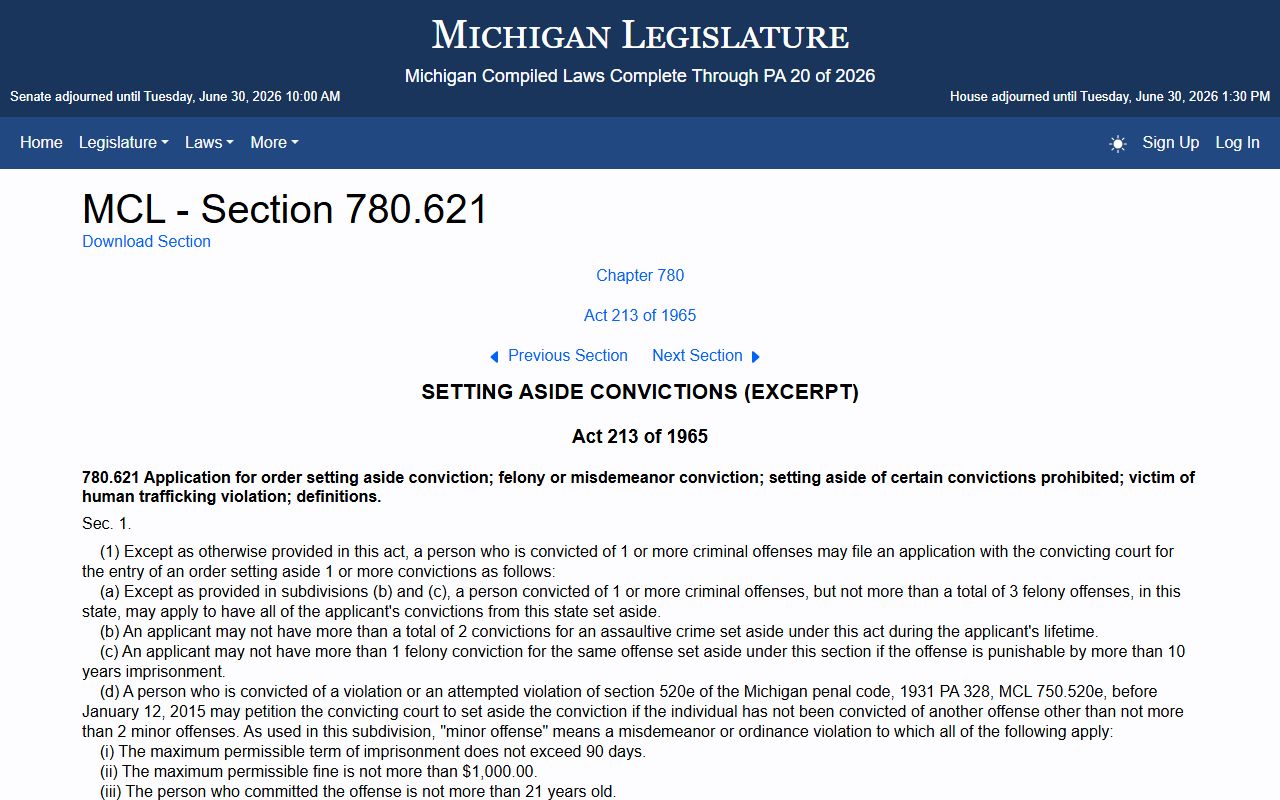
Waiting periods, offense limits, and exclusions decide whether a conviction qualifies before any petition is filed. The general path runs like this.
- Check whether the conviction qualifies under Michigan's expungement laws.
- Confirm any waiting periods, limits on the number of offenses, and offense exclusions.
- File the petition, or rely on the automatic process if the offense qualifies.
- Provide fingerprints and notice as the statute or court rules require.
- Wait for the court's order and the prosecutor's response period.
- Once granted, the conviction is set aside and should no longer appear as a normal public record.
Some records clear without any petition at all. Under Michigan's automatic expungement law, MCL 780.621g, certain convictions are set aside on a schedule with no application required.
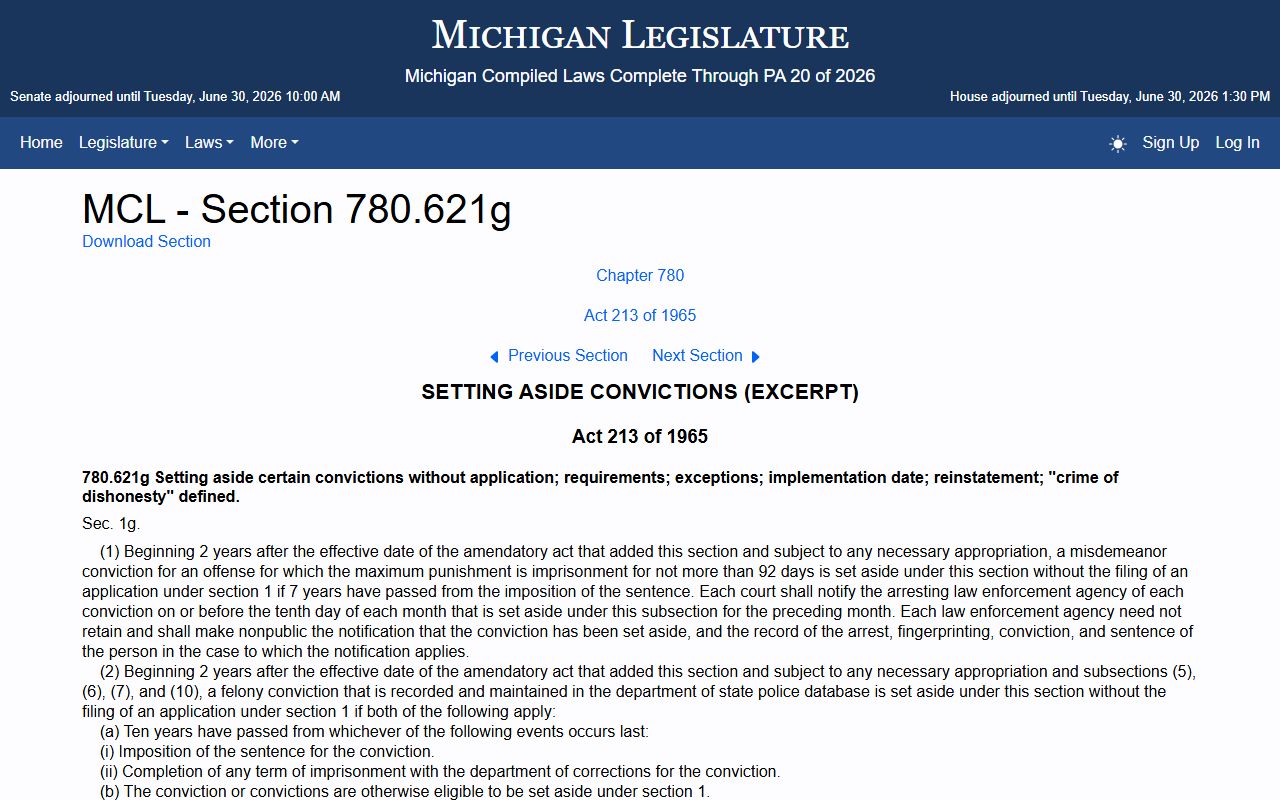
That process runs in the background, so a person may find an old conviction already removed from the public record. The county does not publish a local sealing office, so filing questions go to the 57th Circuit Court.
Public Access to Emmet County Criminal Court Records
Criminal case files are public records in Michigan unless a rule or statute limits them. Access runs through two channels. The court side uses MiCOURT and the clerk's office under the Michigan Court Rules. The administrative side uses the Freedom of Information Act for county records that sit outside the court file. Michigan Court Rule 8.119 sets how trial courts keep and share records, while FOIA gives a written-request path for other government records.
Key Statutes:
MCL 15.235 - Public-record requests must be made in writing and are handled under Michigan's FOIA.
MCL 28.242a - Criminal-history information may be shared only under the limits set by statute.
Federal Criminal Cases in Emmet County
Not every criminal case in the county is a state case. Federal crimes such as major drug, fraud, and firearm offenses are prosecuted separately. Emmet County sits in the Western District of Michigan, Southern Division, and those cases are filed in Grand Rapids, not Petoskey.
Federal charges here are brought by the U.S. Attorney for the Western District of Michigan, whose office covers Emmet County among many others.
The federal case record is held by the U.S. District Court, and detailed access runs through the PACER electronic system rather than the state portal.
The district page for the U.S. Attorney lists every county and office location across the western half of the state.
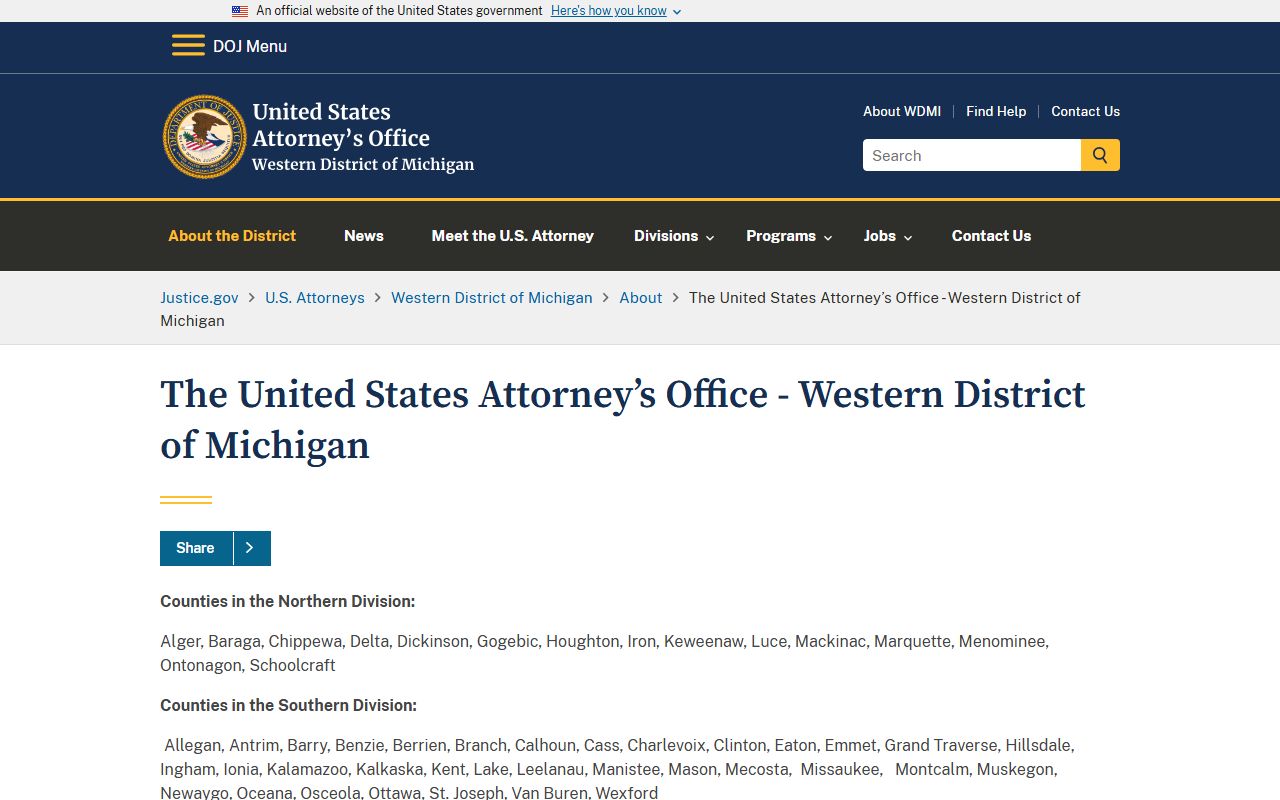
For an Emmet County defendant, the practical federal access point is Grand Rapids, since no federal courthouse sits in the county.
Background Check Considerations
A casual name search is not a background check. Employers, landlords, and licensing bodies that rely on criminal records for a decision fall under the Fair Credit Reporting Act. Those checks must use a regulated consumer reporting agency and follow strict notice and accuracy rules. A quick MiCOURT lookup is fine for general reference, but it is not a compliant screening report.
Important: This site is not a consumer reporting agency under the FCRA, and its information may not be used for employment, tenant, credit, or other FCRA-regulated screening.
Restricted Criminal Court Records in Emmet County
Some criminal records stay closed to the public. Juvenile cases are the clearest example. Michigan law under MCL 712A.28 keeps most juvenile case records confidential and open only by court order in many situations. Sealed and suppressed cases may show limited metadata or nothing at all. Ongoing investigations, warrants not yet served, and mental-health matters carry their own limits.
Expunged convictions drop out of the normal public file. Adoption records are sealed. When a record cannot be found online, the County Clerk or the county FOIA office is the next step.
Note: A record that appears missing online may still be requested by court order, so the clerk can explain whether a specific file is truly sealed or simply not yet digitized.