
How to Search Emmet County Court Records
The central public case-search system for the county is Michigan's MiCOURT case search. The state runs it, and the county clerk and both trial courts link to it. Civil, traffic, criminal, domestic, and probate cases may all appear, depending on which court you search. The county clerk points people here for circuit-court cases, and the district and circuit court pages each embed a MiCOURT view.
The county pages are clear that MiCOURT data is provided by the State of Michigan. Emmet County does not create, maintain, or control it. If a case date or status looks wrong, the county tells you to call the court that holds the file rather than trust the screen. Before you start, it helps to have a name spelled the way it appears in the case, a case number if you have one, and a rough date range.
Searching is free and needs no account. Follow these steps for a clean lookup:
- Open the court-specific MiCOURT page for either the 90th District Court or the 57th Circuit Court.
- Search by last name first if you do not have a case number.
- Use the court filter to keep district and circuit results apart.
- Add date, judge, or case-status filters when a name is common.
- Open the full docket instead of trusting the short search summary.
The MiCOURT case search home page shows the statewide entry point and its record scope.
The MiCOURT case search home is where most Emmet County court records searches begin.
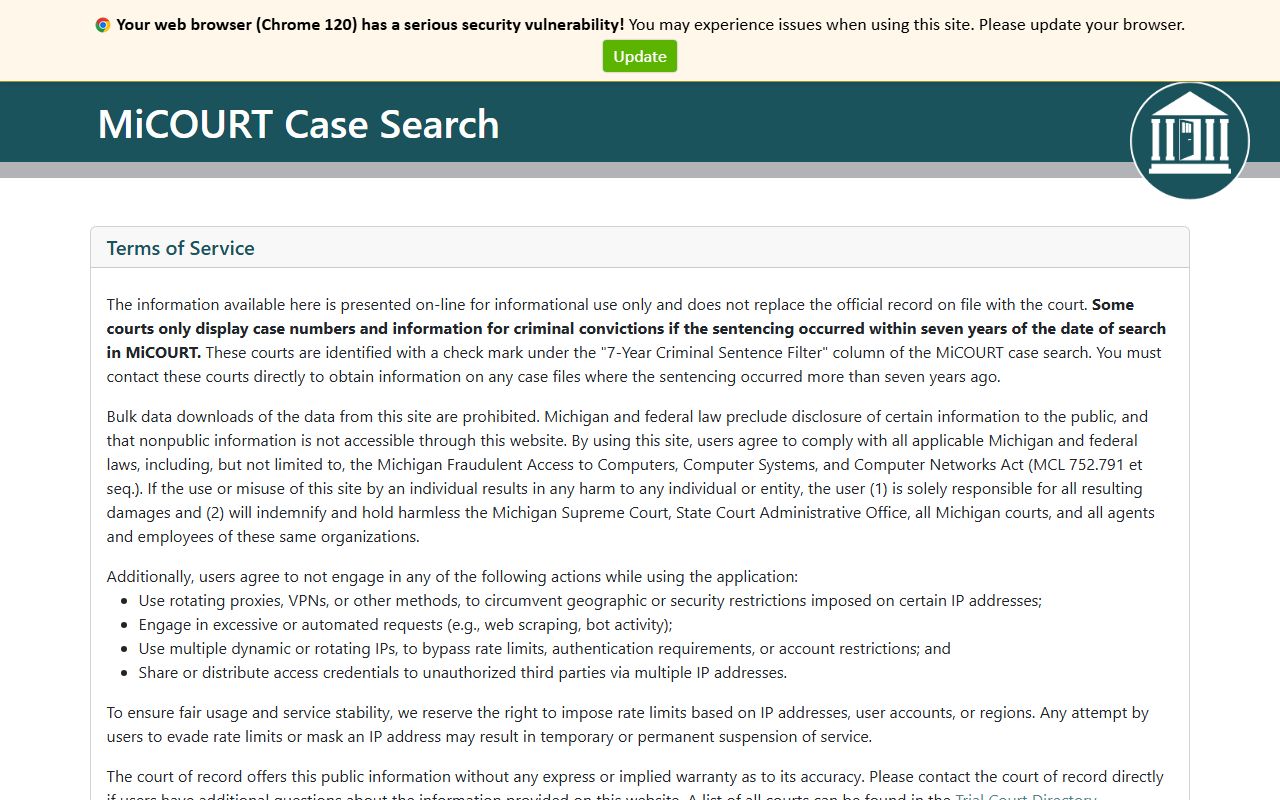
From this page a searcher picks a court, enters a name or case number, and moves into the county-specific results for Emmet County court records.
District and Circuit Court Case Search
Emmet County uses separate MiCOURT entry points by court level. The 90th District Court handles traffic, misdemeanors, landlord-tenant disputes, small claims, and civil claims up to $25,000. Its case search opens the district docket for the county.
The 90th District Court case search is the right start for tickets, misdemeanor charges, and lower-value civil matters.
District results stay separate from circuit results, which keeps a traffic ticket from getting mixed up with a felony file. The 57th Circuit Court hears felony criminal cases, civil cases over $25,000, family-division matters, and appeals from the lower courts. Its search reaches the county's higher-level trial records.
The 57th Circuit Court case search covers felonies, major civil suits, and family cases such as divorce and personal protection orders.
When a date or status is unclear, call the court that owns the record. The district court answers at (231) 348-1750, and the circuit court answers at (231) 348-1711. Staff can confirm a hearing time or tell you when a paper file must be pulled by hand.
Emmet County Court Records Search Fields
The public MiCOURT portal is built in JavaScript, so its field labels are documented best in the state's own API guide. That guide lists every input and filter the search accepts, which is useful when a common name returns too many hits. The fields below let you narrow an Emmet County court records search by person, case, date, or money owed.
The MiCOURT case-search API docs spell out the official search fields and result model.
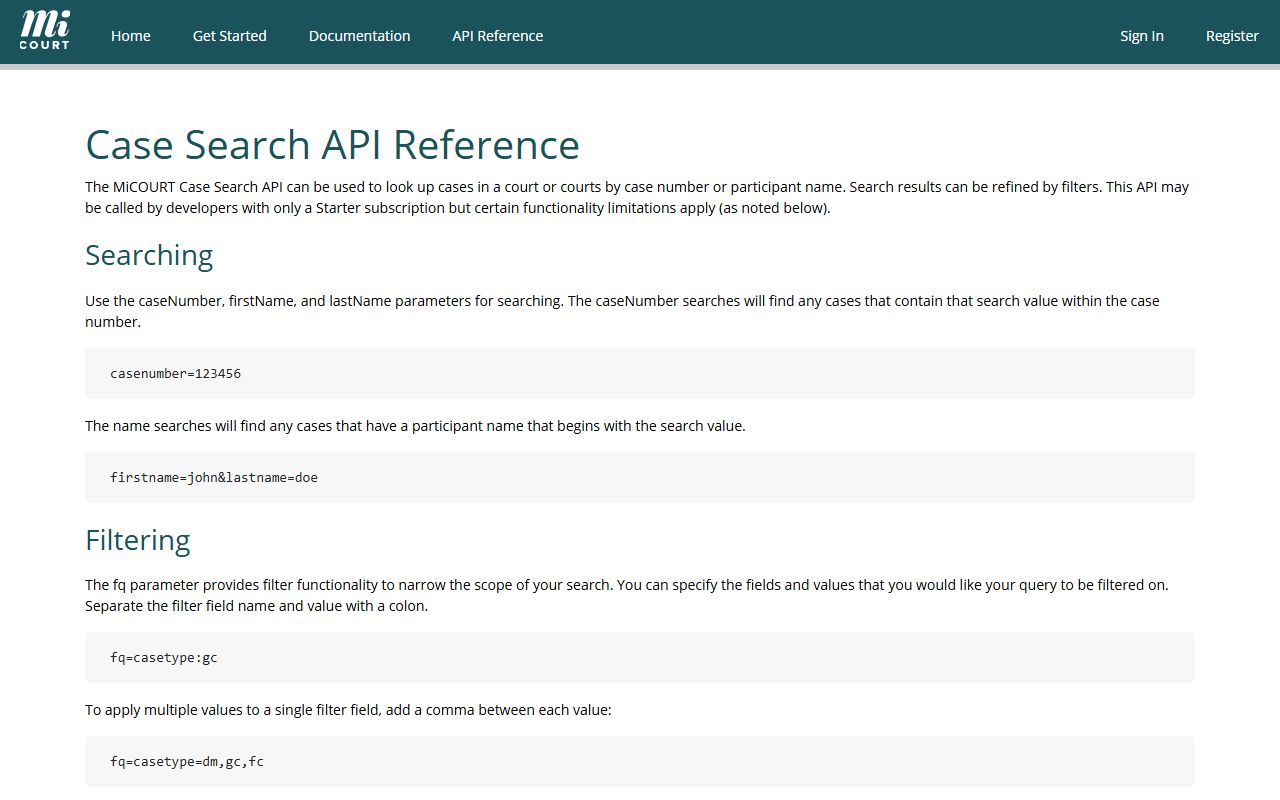
These documented fields map to the same filters the county's embedded search exposes:
| Field Label | Type | Required | Notes / Format |
|---|---|---|---|
| caseNumber | Text | No | Case number lookup |
| firstName | Text | No | Person search |
| lastName | Text | No | Person search |
| caseType | Dropdown | No | Court-specific case type |
| caseTypeCategory | Dropdown | No | Adoption, appeals, civil, criminal, domestic, juvenile, non-traffic, probate, traffic |
| caseTypeSubCategory | Dropdown | No | Narrower court category |
| caseYear | Text or dropdown | No | Case year filter |
| caseStatus | Dropdown | No | ADR, closed, deferred, disposed, mediation, open |
| casePublicStatus | Dropdown | No | Public or suppressed |
| judge | Text | No | Judge filter |
| dob | Date | No | Date of birth |
| petitionStatus | Dropdown | No | Petition filter |
| amountDue / amountPaid | Numeric | No | Amount filters |
| fileDateFrom / To | Date | No | Filing date range |
| offenseDateFrom / To | Date | No | Offense date range |
| dispositionDateFrom / To | Date | No | Disposition date range |
| dln / dlnState | Text | No | Driver license number and state |
| vpn / vpnState | Text | No | Vehicle plate number and state |
The docs also note that results sort by newest, oldest, or case ID, and that a page returns 20 records by default. Expanded data can add charges, judge, next hearing, participants, petitions, and referee. The wider result sets are tied to paid subscriptions, so basic public access shows less than a court-clerk account would.
Types of Emmet County Court Records
The county's record set splits by court and by subject. The 57th Circuit Court holds felonies and larger civil suits. The 90th District Court holds traffic, misdemeanor, and smaller civil files. The 7th Probate District Court holds estates and guardianships. Family cases, name changes, and personal protection orders sit in the circuit court's family division.
Portal filters and file labels often use short codes. Civil files read as CV, criminal as CR, family as FM, juvenile as JV, probate as PR, and traffic uses TC or a traffic tag. The main public categories break down like this:
- Civil records, including circuit claims over $25,000 and district claims up to that limit, plus landlord-tenant matters.
- Criminal records, with misdemeanors in district court and felonies in circuit court.
- Family records, such as divorce, paternity, adoption, and protective orders in the circuit family division.
- Probate records, covering wills, estates, guardianships, conservatorships, and mental-health matters.
- Traffic and small-claims records, along with eviction cases, handled by the district court.
Not every category is fully open. Juvenile, sealed, expunged, adoption, and mental-health files are limited by rule or statute. The county publishes no separate municipal or justice-court stack, which keeps the search simpler than in states that split traffic and misdemeanor work across several local courts.
What Emmet County Court Records Show
A search result is only the start. The docket is where the useful chain of events lives. For a criminal case that means the charge, arraignment, plea, motions, hearing resets, sentence, and probation entries. For a civil case it means the complaint, answer, scheduling, mediation, judgment, and any collection steps. The table below lists the fields a public record commonly shows.
| Field | What It Shows |
|---|---|
| Case Number | The court's unique file identifier, used for exact lookups. |
| Court Name | Which court holds the case, such as the 90th District or 57th Circuit. |
| Filing Date | When the case was opened with the clerk. |
| Case Type or Code | The category, shown as codes like CR, CV, FM, or PR. |
| Party Names | Plaintiff, defendant, petitioner, or respondent on the case. |
| Attorney Names | Counsel of record for each side, where listed. |
| Judge or Referee | The judicial officer assigned to the matter. |
| Hearing Dates | Past and upcoming court events. |
| Docket Entries | The step-by-step log of filings and orders. |
| Disposition | How the case ended or was resolved. |
| Sentence | The penalty imposed in a criminal case, if any. |
| Payment or Balance | Fines, costs, and amounts owed where the portal shows them. |
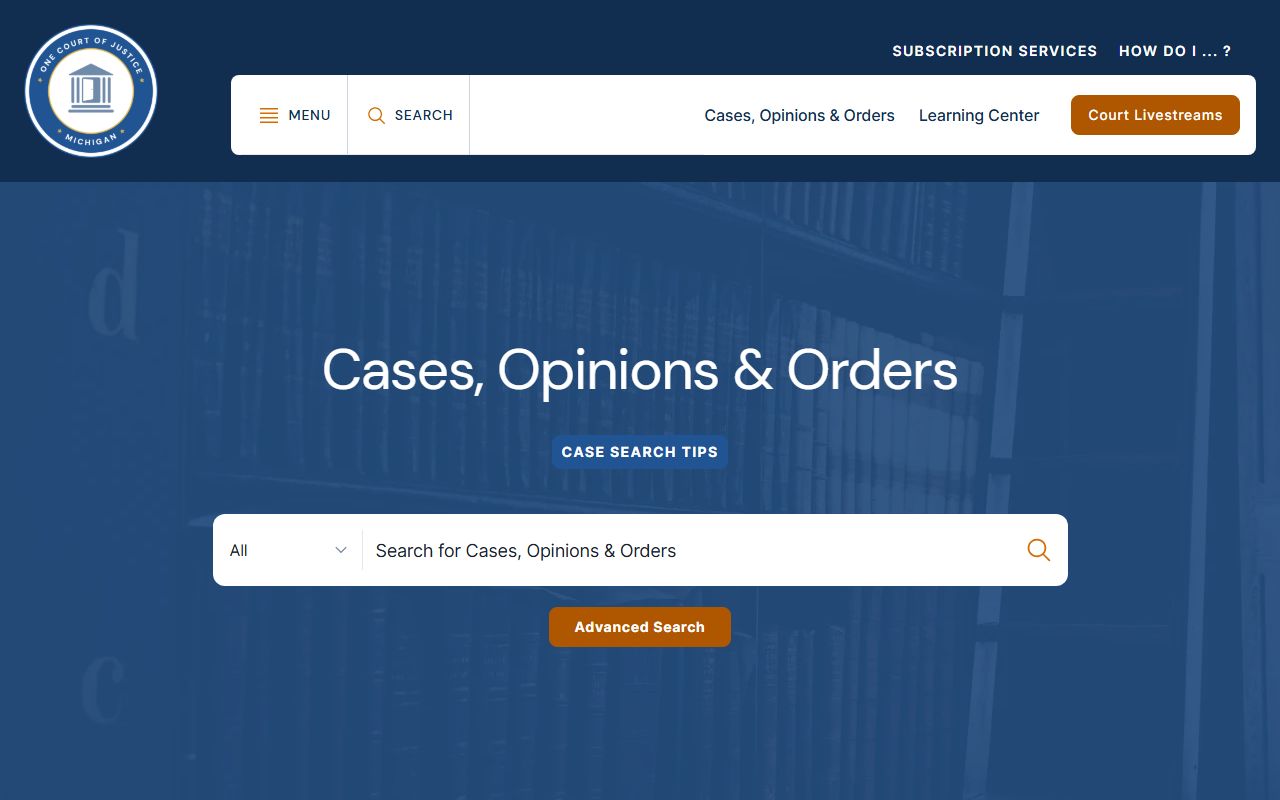
The statewide results and opinions view gives a wider look at how Michigan presents case data.
The Michigan courts cases, opinions, and orders page ties local dockets to the state's broader search and ruling library.
Some data is trimmed for privacy. Social Security numbers should not show in the public file, account numbers are usually truncated, and minor or juvenile identifiers are often withheld. A few terms come up again and again in these records:
- Plaintiff
- The person or entity that starts a civil case.
- Defendant
- The person or entity responding to a case.
- Disposition
- How the case ended or was resolved.
- Bond
- Money or conditions set for release in a criminal case.
- Docket
- The running log of every filing and order in a case.
The full event history for a file also appears in the Emmet County court dockets, which track hearing dates and case status side by side with the search summary.
Public Access Framework for Emmet County Court Records
In Michigan, the first stop for a public record is the office that creates or keeps it. Court files are searched through MiCOURT or requested from the clerk, while county administrative records go through the FOIA office. State law gives the public a written-request path for government records under MCL 15.235, which sets out how a Freedom of Information Act request must be made and handled.
That access is not unlimited. MCL 15.243 lists the records and information that are exempt from disclosure. Court records carry a second layer of rules on top of FOIA. Under MCR 8.119, Michigan's court-record standards govern how case files are kept, released, and restricted, so a court file can be open, limited, or sealed regardless of the general FOIA rule.
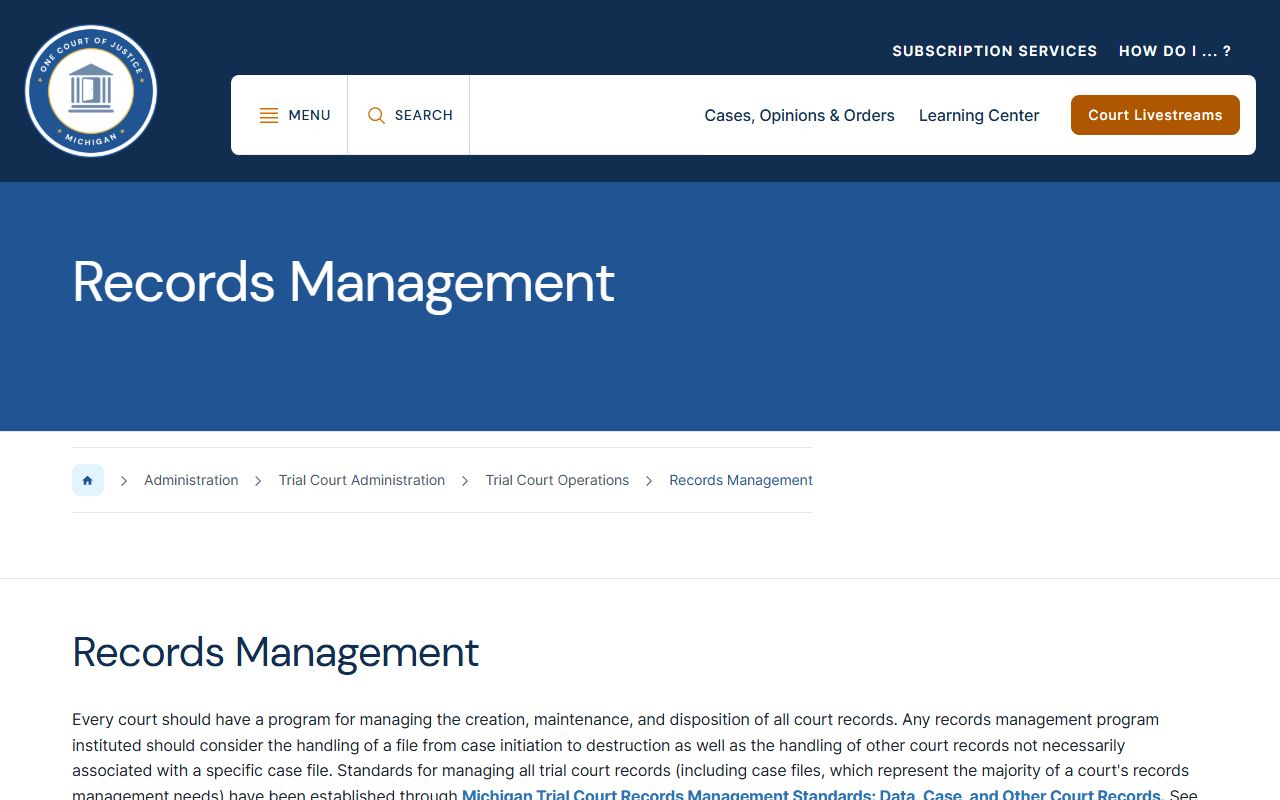
The state's records-management standards page explains how trial courts store and release case files.
Michigan's court records management standards set the retention and access rules that Emmet County follows.
Fees and ID rules depend on the office and the copy type. Online viewing on MiCOURT is free, but a certified copy for legal use must come from the clerk or the court that holds the file.
Note: An online MiCOURT screen is not a certified record, so any filing or legal proceeding will need a certified copy pulled by the clerk or court.
Records That Are Sealed or Confidential in Emmet County
Several categories never appear in an ordinary public search. Juvenile files are heavily restricted, sealed cases are hidden from normal access, adoption records are limited, and mental-health proceedings are often confidential. Expunged convictions drop out of public view once a court sets them aside. Protected identifiers such as Social Security and account numbers are redacted even in open files.
Michigan sets these limits by statute. MCL 712A.28 keeps juvenile case records restricted and open only by court order in many situations. Convictions can be set aside by petition under MCL 780.621, and some qualify for automatic relief under MCL 780.621g. Criminal-history information may be shared only under the rules in MCL 28.242a. The Michigan Court Rules add the record-access framework that governs sealing.
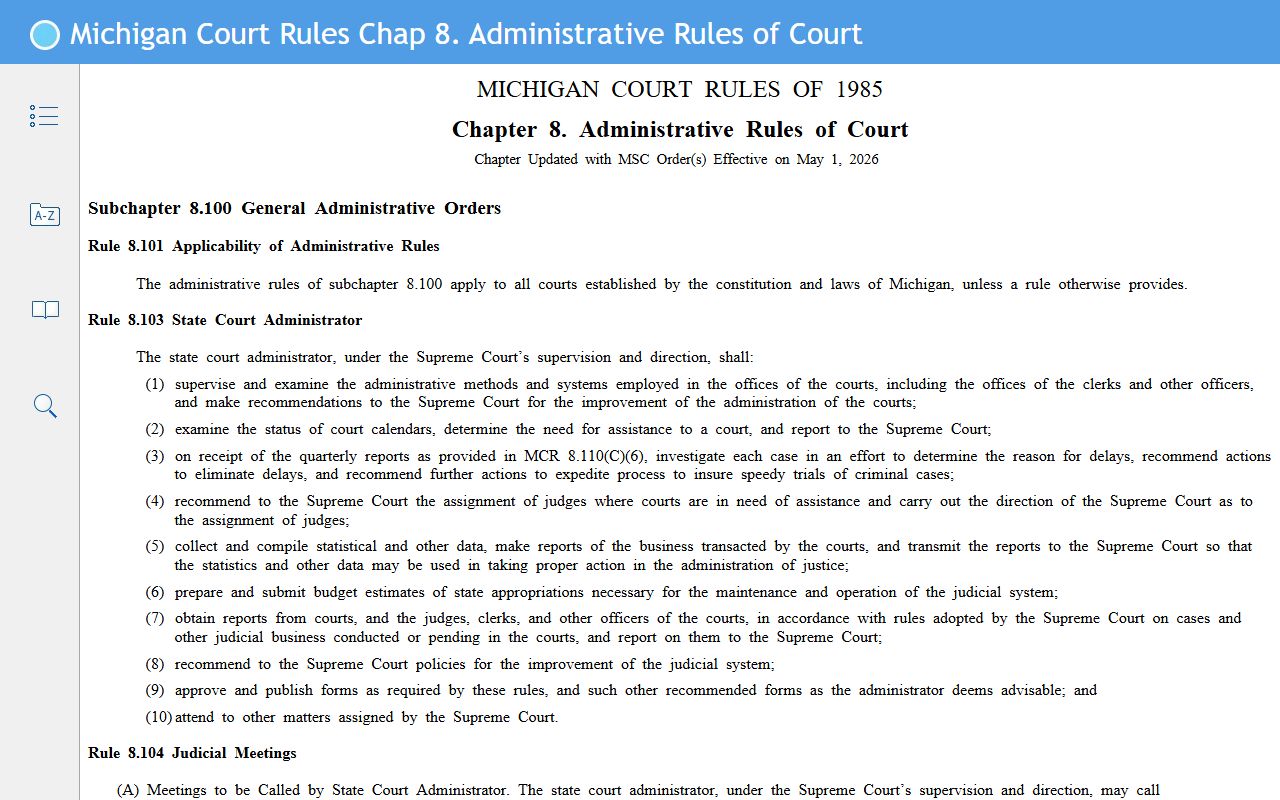
Chapter 8 of the Michigan Court Rules holds the public-access rule that decides what stays open.
The Michigan Court Rules chapter 8 sets out MCR 8.119 and the standards for restricting or releasing a case file.
The county publishes no local expungement clinic or sealing office. To clear or restrict a qualifying record, follow the state process:
- Check whether the conviction qualifies under Michigan's set-aside laws.
- Confirm any waiting period, offense-count limit, or exclusion that applies.
- File the petition, or rely on the automatic process if the offense qualifies.
- Provide fingerprinting or notice as the statute or court rules require.
- Wait for the court's order and any prosecutor response period.
In-Person, Mail, and FOIA Requests
Not every record sits online. Older paper-only files, certified copies, and anything not digitized still need a manual pull. The County Clerk is the hub for circuit-court files and many request forms, and the office also serves as clerk of the 57th Circuit Court. Walk-in and mail requests both run through Suite 130 during regular county hours. Bring a photo ID, the case number if you have one, and payment for any certified copy.
Emmet County Clerk
200 Division St., Suite 130
Petoskey, MI 49770
(231) 348-1744
Mon-Fri 8:00 a.m. to 5:00 p.m.
County administrative records that are not court files follow a different path. Those go to the county FOIA office in Suite G70 at 200 Division Street, which handles written Freedom of Information Act requests for Emmet County. The county FOIA office can take a request through the county website or in person at the administration desk. Court files, though, are usually faster through MiCOURT first, then the clerk, and only through FOIA when the record is not part of a normal court search.
The safest order for most people is simple. Search MiCOURT for the case, note the case number and court, then contact the County Clerk for a certified copy or a file that the portal does not show. Anything sealed or suppressed will need a court order before the clerk can release it.