
Emmet County Arrest Records and Court Charges
An arrest record is the account of an arrest itself. It shows who was taken into custody, the arresting agency, and the booking that follows at the jail. In Emmet County that booking side runs through the Emmet County Sheriff and the jail at 450 Bay Street in Petoskey. A court charge record is a different thing. Once someone is arrested, the Emmet County Prosecuting Attorney reviews the case and decides what formal charges to file. Those charges are filed with the court and become the charge record that the public can search. Mike Schuitema was elected Emmet County Prosecuting Attorney to a four-year term on November 5, 2024, and the office files violations of criminal law on behalf of the People of the State of Michigan.
The split matters when you look for court charges after arrest. The arrest and booking detail live on the sheriff side, and there is no county-hosted public roster, so custody status runs through channels like VINE and the jail itself. Those channels are covered on the Emmet County inmate records page. The charge record lives in the trial courts. Misdemeanor charges are filed in the 90th District Court, and felony charges move to the 57th Circuit Court. The full case file, with pleas, hearings, and the final outcome, is described on the Emmet County criminal court records page.
Being named in an arrest record does not settle guilt. It marks the start of a process that the charge record then tracks.
How to Find Emmet County Arrest Records and Charges
The charges filed after an arrest show up in Michigan's court case search. Emmet County does not run its own case database. It relies on the statewide MiCOURT case search, with separate entry points for each local court. Felony charges appear in the 57th Circuit Court case search, and misdemeanor charges appear in the 90th District Court case search. The booking detail behind the arrest is a separate lookup, so a full picture often means checking both the court file and the jail channels.
- Open the MiCOURT case search page for either the 57th Circuit Court or the 90th District Court.
- Search by the defendant's last name, or by the case number if you already have it.
- Open the case and read the charge list, since one arrest can produce several separate charges.
- Check each charge's statute code, level, and current status, then read the docket for the latest event.
When a date or status looks unclear, the courts ask that you call them directly rather than trust a summary line. The 90th District Court answers at (231) 348-1750, and the 57th Circuit Court answers at (231) 348-1711.
How Charges Get Filed After an Emmet County Arrest
The charge record begins when the prosecutor files a charging document. The type of document depends on how serious the offense is and how the case is brought. A misdemeanor usually starts with a complaint in the 90th District Court. A felony also starts with a complaint, then moves through a preliminary examination in district court. If the judge finds enough evidence, the prosecutor files an information in the 57th Circuit Court, and the felony case proceeds there. Grand jury indictments are far less common in Michigan, but they remain an option for serious matters.
| Complaint | Information | Indictment | |
|---|---|---|---|
| Filed By | Officer or prosecutor | Prosecutor | Grand jury |
| Common For | Misdemeanors and the first felony step | Felonies bound over to circuit court | Rare, serious felonies |
| Court | 90th District Court | 57th Circuit Court | 57th Circuit Court |
Note: The charging document is where the charge record starts, so its filing date is often the first date you will see attached to the charges.
Emmet County Charge Status and What It Means
Charges are not fixed once they are filed. As a case moves, a prosecutor can amend a charge, reduce it, add one, or drop it. A judge can dismiss a charge. Reading the current status is the only way to know where a charge stands, because an early charge line can change many times before a case ends. The terms below appear often in Emmet County charge records.
| Status | What It Means |
|---|---|
| Pending | The charge is filed and the case is still open, with no final ruling yet. |
| Amended or Reduced | The prosecutor changed the charge, often to a lower level or a different statute. |
| Dismissed | The court ended the charge, sometimes with prejudice so it cannot be refiled. |
| Nolle Prosequi | The prosecutor chose to drop the charge and not pursue it. |
Charges vs. Convictions in Emmet County
A charge is an accusation. A conviction is a result. The gap between the two is wide, and mixing them up is one of the most common mistakes people make when they read arrest and charge records. A charge only needs probable cause to be filed. A conviction requires proof beyond a reasonable doubt, reached by a plea or a verdict.
| Charge | Conviction | |
|---|---|---|
| Stage | Accusation after arrest | Verdict or plea |
| Burden of Proof | Probable cause | Beyond a reasonable doubt |
| Public Record | Yes, unless restricted | Yes, unless set aside |
A person can be charged and never convicted. Charges get dropped, reduced, and dismissed every term.
Sealed vs. Expunged Charge Records
Michigan limits how long some charge outcomes stay in ordinary public view. A sealed record is hidden from routine public search, though a court order can still open it. Expungement in Michigan is the setting aside of a conviction. Under MCL 780.621, a person can petition to set aside a qualifying conviction, and under MCL 780.621g some convictions are set aside automatically without any application. A set-aside conviction should no longer appear as a normal public conviction.
| Sealed | Expunged (Set Aside) | |
|---|---|---|
| Visibility | Hidden from public search | Removed from ordinary public access |
| Law Enforcement | Limited access | Very limited access |
| Eligibility | By court order under Michigan Court Rules | By petition or automatic set-aside under Michigan law |
Emmet County Charge Codes and Severity Levels
Every charge ties back to a statute, and the statute sets the severity level. In Michigan that level decides which court hears the charge. Felonies carry the heaviest penalties and are handled by the 57th Circuit Court. Misdemeanors are lighter and stay in the 90th District Court. Civil infractions, such as many traffic matters, are lighter still and are not treated as crimes at all. One arrest can create a mix of these, so a single case may list a felony count next to a misdemeanor count.
Charge lines usually carry a short code plus the statute number. Reading both tells you what the accusation is and how serious the county treats it. When a code is hard to read, the clerk or the charging court can explain what it maps to.
Statewide Charge and Criminal History Lookups
Charges in Emmet County also roll up into a statewide criminal history. Michigan controls how that history is shared under MCL 28.242a, which sets rules on the dissemination of criminal history information. For court files that are not online, a written public records request is the path, since MCL 15.235 requires public record requests to be made in writing under Michigan's Freedom of Information Act. The clerk holds many court records, and the county FOIA office handles administrative records.
A statewide lookup and a county case search are not the same. The county search shows the local charges and docket. The statewide history pulls charges together across courts, and access to it is tighter than a routine name search.
Federal Charges After an Emmet County Arrest
Not every arrest leads to a state charge. Some cases are charged in federal court instead. Emmet County sits in the U.S. District Court for the Western District of Michigan, and the district's own county list confirms Emmet County falls in its Southern Division. Federal charges are filed by the United States Attorney rather than the county prosecutor.
The county coverage is spelled out on the court's Western District of Michigan county list, which is worth checking when a case appears to be federal rather than local. The image below shows that page.
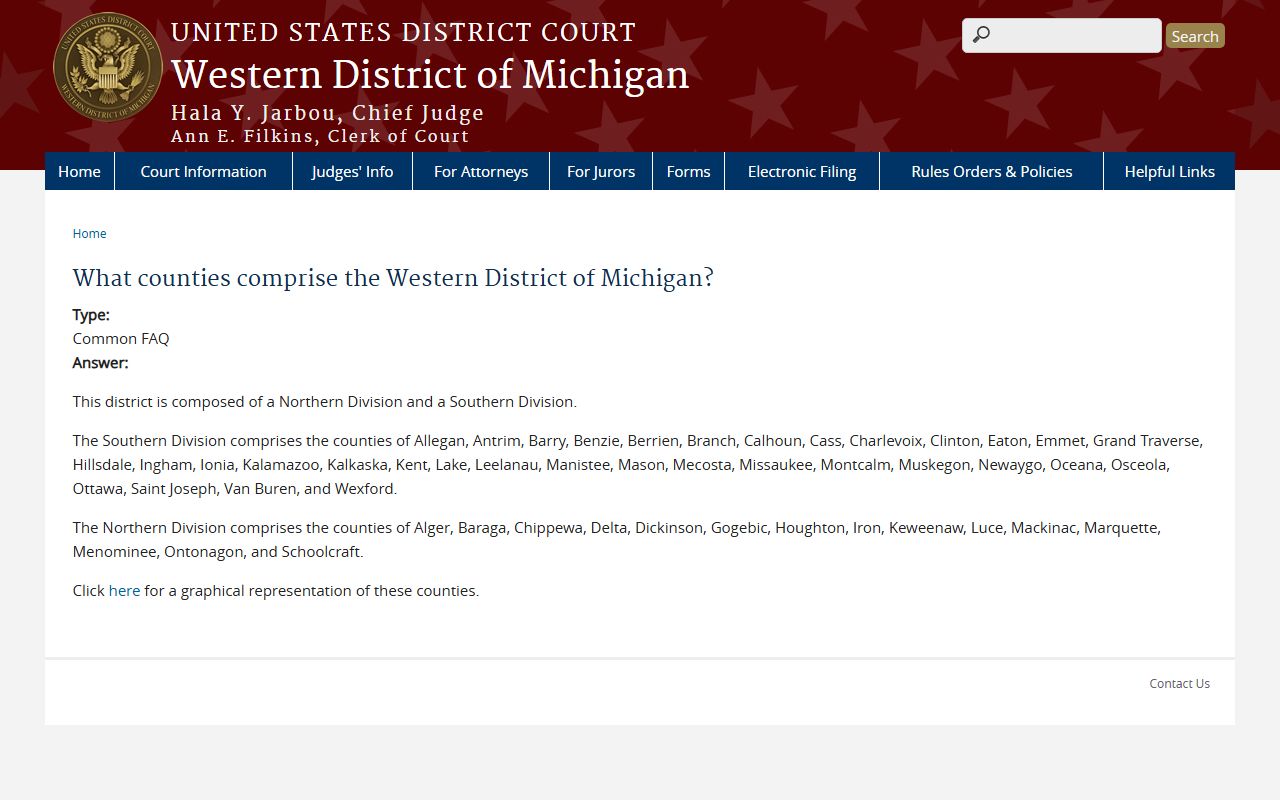
That coverage list is how a reader confirms federal jurisdiction over an Emmet County matter before searching further.
Federal case files are held in a separate system. The court's home page links its filing and access tools, and case records are searched through PACER. The PACER lookup for the Western District of Michigan is the official directory entry for the district court, shown below.
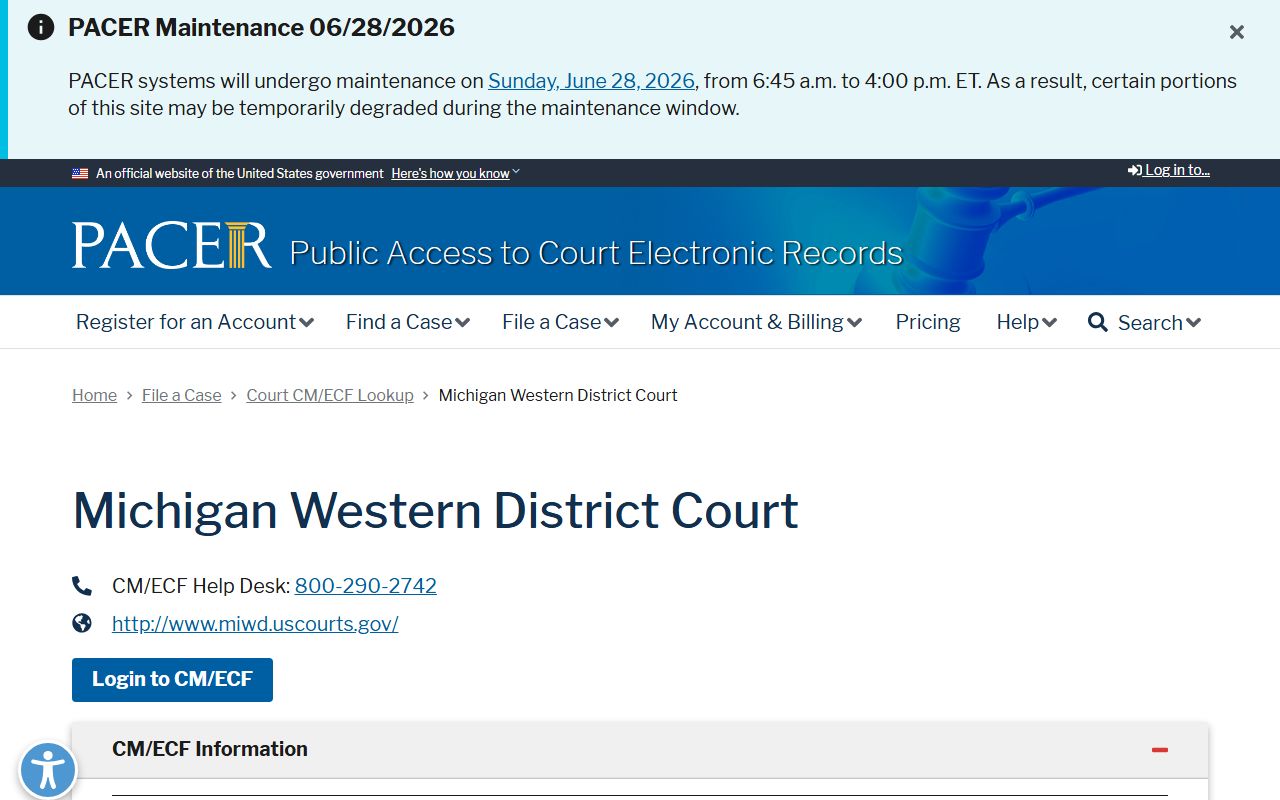
PACER registration is required for most detailed federal access, so it is a step beyond the free county search.
Questions about a federal charge go to the prosecuting office, not the county. The district court home page is the starting point for the court side, pictured here.
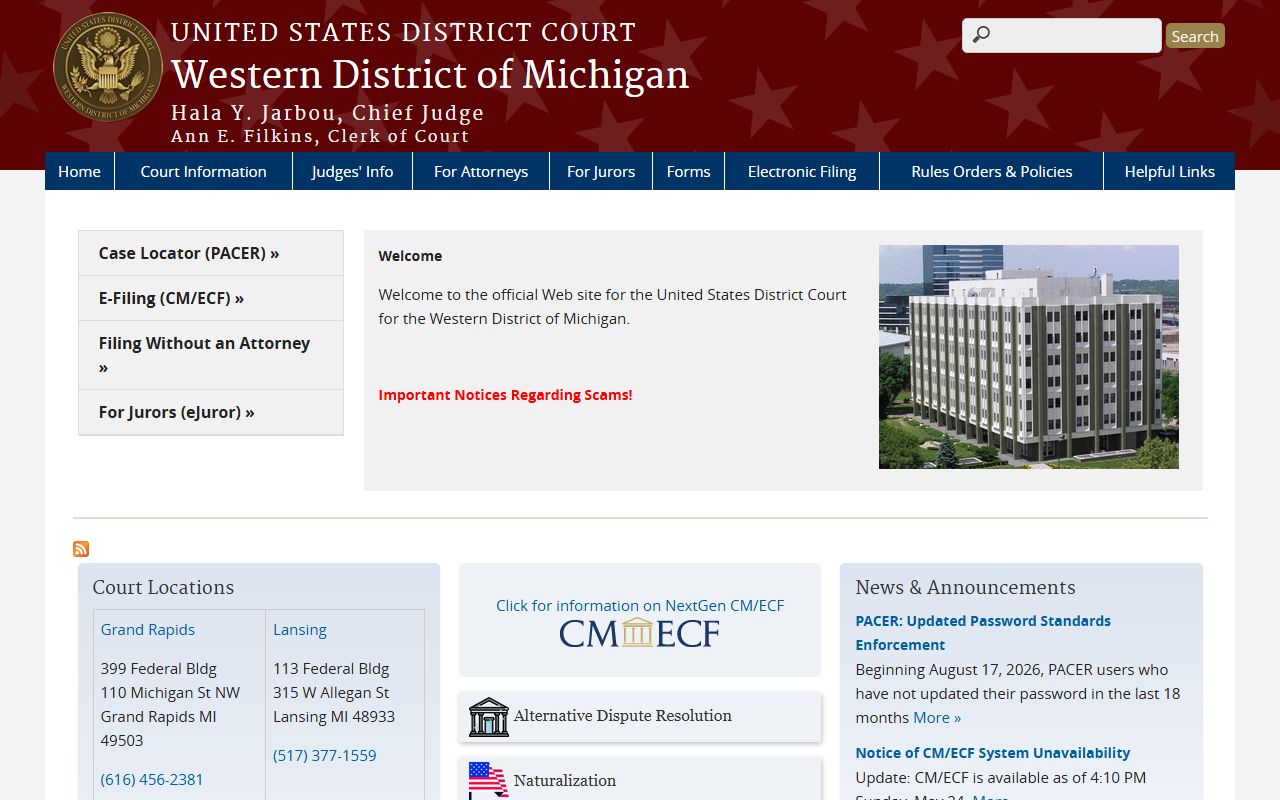
The court handles the case file, while the prosecuting side is a separate office with its own contacts.
For the charging authority, the U.S. Attorney's Office for the Western District of Michigan lists its contact details, shown below, and its main office is in Grand Rapids.
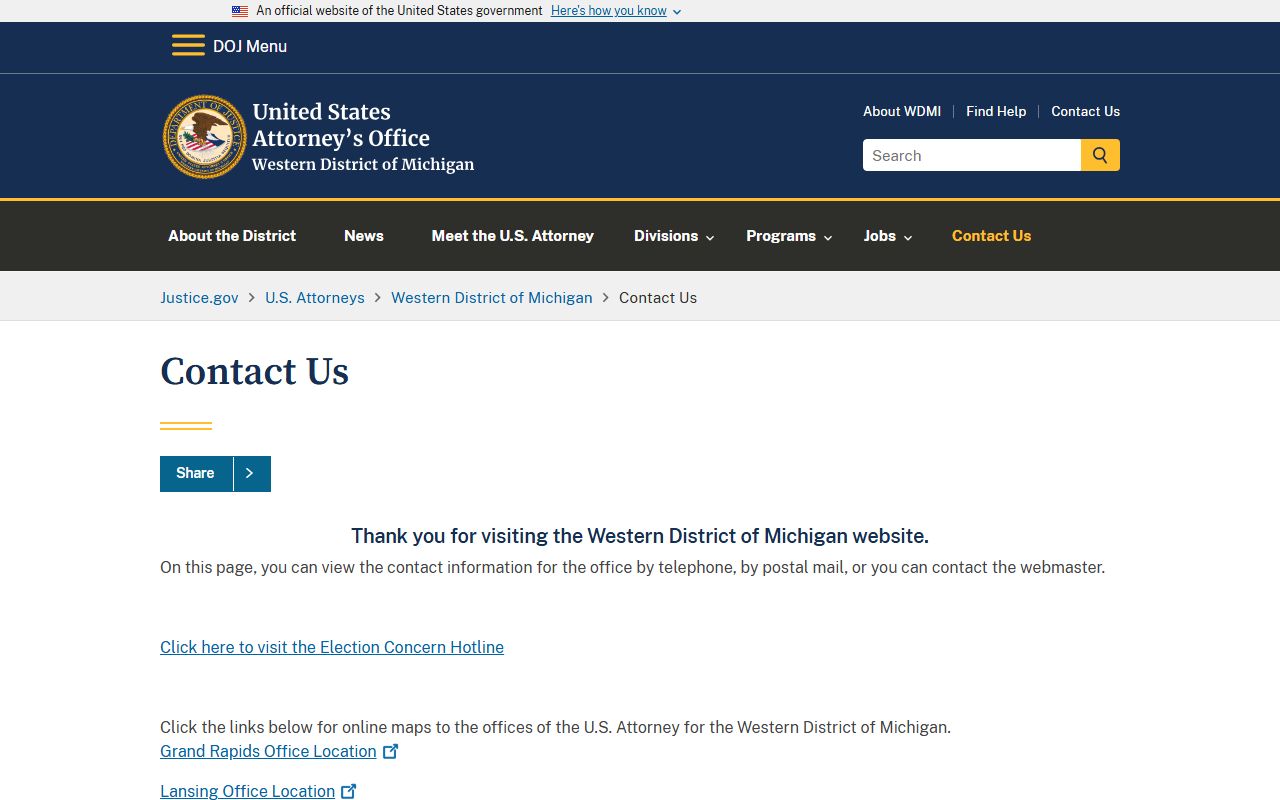
No federal courthouse sits in Emmet County itself, so the practical federal access point for the county is Grand Rapids.
Background Check Considerations
People sometimes treat a charge lookup as a background check. They are not the same. A formal background check that is used for hiring, housing, or credit must follow the federal Fair Credit Reporting Act, and it runs through a regulated consumer reporting agency. A casual name search of court charges does not carry those protections and can be incomplete or out of date.
Important: This site is not a consumer reporting agency under the FCRA, and its information may not be used for credit, employment, tenant, or insurance decisions.
Restricted Charge Records in Emmet County
Some charge records are not open to the public. Juvenile charges are tightly restricted under MCL 712A.28, which keeps juvenile case records confidential and open by court order in many situations. Sealed charges are hidden from routine search. Charges tied to an active investigation may be withheld until the matter is further along. Set-aside convictions should drop out of the public view once the court grants the order.
When a charge does not appear online, that absence does not always mean the charge does not exist. It may be restricted, not yet digitized, or filed in another court. A written request to the clerk or the county FOIA office is the way to ask about a record that the public search does not show.